
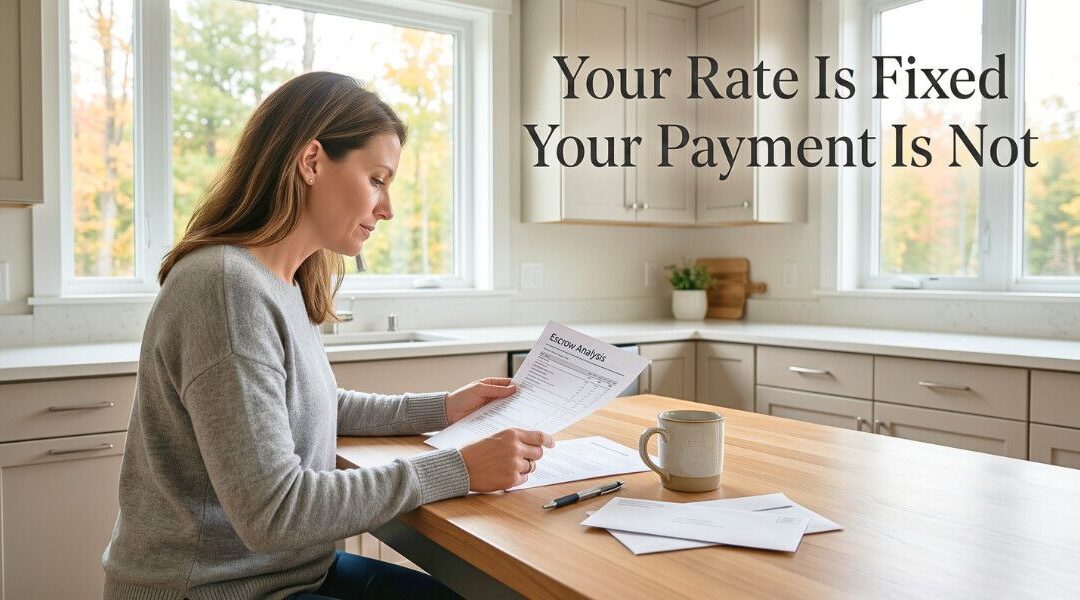
If you’ve ever heard “Congrats, your rate is locked!” and felt your shoulders drop, you’re not alone. For most buyers, that moment means relief and certainty.
It also leads to a common assumption: if my rate is locked, my payment must be locked as well.
Here’s the reality I explain upfront, because I would rather you be prepared than blindsided later. A fixed interest rate locks your rate. It does not lock your total monthly payment.
When a payment changes a year later, it usually does not mean anyone changed your loan. It means the parts of homeownership that live outside the loan did what they are designed to do. They adjusted to fluctuating real-world costs.
Let’s break this down in plain English, so you know exactly what to expect.
The Four Parts of a Mortgage Payment
Most monthly payments are made up of four pieces, often called PITI.
- Principal is the portion that pays down your loan balance
- Interest is the cost of borrowing the money
- Taxes are your local property taxes
- Insurance is your homeowners’ insurance policy
With a fixed-rate mortgage, the principal and interest payments follow the schedule you signed at closing. Those do not change unless you refinance.
Property taxes and insurance are different. They are real-world costs set by local governments and insurance carriers. When they change, your escrow payment changes with them.
Understanding Escrow
Escrow is essentially a built-in savings account managed by your mortgage servicer. Instead of you paying property taxes and insurance in one or two large lump sums each year, you pay one-twelfth every month. The servicer then pays those bills from the account when they come due.
That means your mortgage payment is really like two payments together: principal and interest on the loan, plus escrow for taxes and insurance.
Here is the key point. If taxes or insurance rates increase, escrow must collect more. And if the servicer paid a higher bill than expected, escrow can come up short. When that happens, the servicer adjusts your payment to cover the new amount and fix the shortage.
That is why escrow changes can feel bigger than expected. You are often paying for the increase while also trying to catch up.
The Panic of Changing Payments
Life moves on after closing. Most people do not remember every detail from their loan documents. So when a new payment notice shows up, the first instinct is panic.
“You told me my rate was fixed. Did my interest rate go up?”
In the overwhelming majority of cases, the answer is no. What usually happens is one of three things:
- Your homeowners’ insurance renewal increased
- Your property taxes have been adjusted
- Your escrow account came up short, and the servicer is correcting it
That is also why people regret ignoring mail that looks boring. Those notices usually explain exactly what changed.
Don’t Ignore Your Escrow Analysis Letter
Most servicers send an escrow analysis once per year. It breaks down what they expected your taxes and insurance to cost and what they actually cost. The letter will also outline whether there was a shortage or surplus and whether there will be adjustments to your payments.
The problem is that these letters are not written for regular humans. They are dense, technical, and easy to misunderstand. If you ever get one and it feels confusing, that is normal.
The solution is simple. Instead of guessing, ask for help. We walk clients through these line by line every week.
When Payments Increase
A first-time buyer I worked with purchased a modest home in northern Indiana. The payment at closing fit comfortably within their budget.
About 11 months later, they received a notice showing a $165 increase in the payment. They were convinced something went wrong with the loan.
When we reviewed the escrow analysis together, the issue was clear. Their insurance carrier raised premiums due to increased rebuild costs in the region. At the same time, property taxes adjusted slightly after the county reassessment. The servicer had paid higher bills than expected, creating a shortage.
Nothing about the loan changed. The rate was the same. But escrow needed to collect more to stay on track.
Because we had planned for year two and kept a buffer, the increase was manageable. More importantly, the borrower understood why it happened. That understanding removed the fear and confusion. That’s the difference between being surprised and being prepared.
Insurance Has Become a Bigger Wildcard Lately
In many Midwest markets, property taxes tend to move more slowly than what you hear about in coastal headlines. Insurance has been the bigger swing factor recently.
Insurance can rise even if you did nothing wrong. Carriers adjust pricing based on local storm patterns, claim volume, rebuild cost inflation, and more.
If you have had claims, bundle changes, or issues on an auto policy tied to your homeowners’ insurance, increases can happen faster. That is one of the most common reasons payments jump in year two.
What This Means for Buyers
Understanding how escrow works changes how you should plan. The goal is not to avoid change. It is to build a budget that can absorb it.
Fixed-rate mortgages are still one of the most stable financial tools available. The world around them moves, including rising insurance premiums that can affect your total payment. Smart planning accounts for that movement.
Protecting Yourself From Payment Shock
Here is the guidance I give clients, especially first-time buyers.
Budget For Year Two, Not Just Year One
Your initial payment is a starting point, not a lifetime guarantee. Do not buy at the absolute edge of what you qualify for. Qualifying and being comfortable are not the same thing.
Keep a Buffer
When you rent, repairs are someone else’s problem. As an owner, they are yours. The true payment is your mortgage plus the ability to handle repairs without panic.
Open Mail That Mentions Escrow, Tax, or Insurance
If it says “escrow analysis” or “payment change notice,” read it. If it does not make sense, send it over. We will explain exactly what changed and why.
Shop For Insurance Early if the Deal Is Tight
Insurance costs can make or break approval when debt-to-income is close. That is why we often recommend getting an insurance quote within the first few days of a contract.
If you want help modeling this, we can build your payment with principal, interest, taxes, and insurance, and stress-test it for realistic changes. You do not have to guess.
Your Questions Answered
Does a fixed-rate mortgage mean my payment can never change?
A fixed rate means the interest rate stays the same. Taxes and insurance can still change, which affects the total payment. That change usually comes from escrow adjustments, not the loan itself.
How often does escrow get reviewed?
Most servicers review escrow annually. They compare expected costs to actual bills and adjust payments accordingly.
Can I pay escrow shortages all at once?
Often yes. Many servicers allow you to pay a shortage in a lump sum rather than spread it over monthly payments. That can keep your payment lower going forward.
Can I remove the escrow entirely?
In some cases, yes. That usually requires sufficient equity and lender approval. It means you would pay taxes and insurance directly instead of monthly.
Why did my insurance go up even without claims?
Insurance pricing reflects regional risk and rebuild costs, not just individual claims. Market-wide adjustments are common.
Should I buy insurance every year?
It can be smart to review quotes periodically, especially if premiums jump. Just make sure coverage stays adequate.
Do escrow increases mean I bought too much house?
Not necessarily. Increases are normal over time. Problems arise when there is no buffer in the budget.
Know What to Expect From Your Mortgage Payments
Fixed-rate loans are still incredibly stable. But taxes and insurance move. If you understand the four parts of your payment and leave yourself some breathing room, year two doesn’t have to be a surprise.
Planning helps you stay in control. Talk with the Durbin Team today to get started and receive guidance from an expert.