
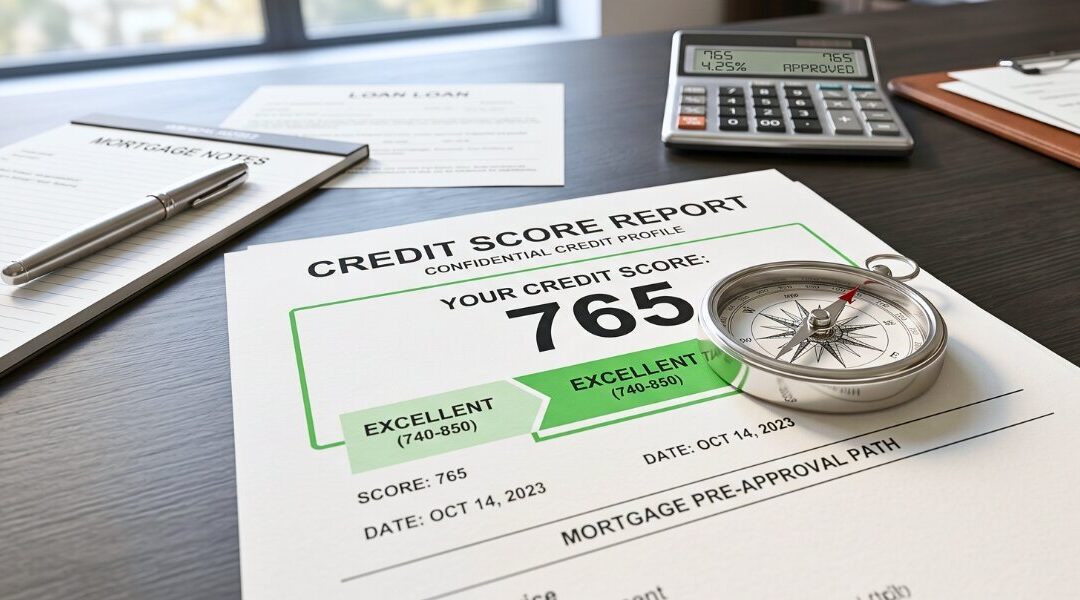
Most borrowers walk into the mortgage process believing their credit score either qualifies them or it doesn't. The reality is that your credit score doesn't just open the door. It also determines how much you'll pay to walk through it.
There's a pricing mechanism built into every conventional loan called loan-level price adjustments, or LLPAs. Fannie Mae and Freddie Mac created them to offset perceived risk at different credit score tiers. The result: two borrowers buying the same house, with the same down payment, can pay vastly different amounts.
Even with the same interest rate, their closing costs can differ significantly. That difference comes down to nothing more than their credit score. Most borrowers never hear the term LLPA once during their entire mortgage process.
Your credit score doesn't just affect whether you qualify for a conventional loan; it directly determines what you pay at closing. Loan-level price adjustments (LLPAs) create meaningful cost differences between credit score tiers, even for those considered good. A rapid rescore can sometimes close that gap in days, not months.
How Much Does a Lower Credit Score Actually Cost on a Conventional Loan?
On a $300,000 purchase with 5% down, and a 740 credit score, you might pay $700 in additional loan-level pricing to secure a given rate. That same rate for a borrower at 720 costs $1,400. Drop to a 700 score, which most people reasonably consider "good credit," and the cost jumps to $2,800, four times the 740 baseline. A 620-score borrower going conventional pays nearly $9,000 more for the identical rate.
This isn't a penalty for bad credit, but a pricing-tier system that applies to scores most buyers would feel confident about.
Many assume loan officers only help borrowers with serious credit problems improve their scores. In practice, that's not how it works. The bigger opportunity is often the borrower sitting at 700, just one statement away from 740. That single move can unlock $2,000 in savings they didn't know were available.
Understanding where you land on the Fannie Mae LLPA pricing grid before you apply matters. It is one of the highest-value conversations you can have with a lender.
Turning a Paid-Off Card Into Real Savings
Let's consider a realistic mortgage borrower situation. A borrower comes in with a 700 score, and everything qualifies, with the borrower getting an acceptable rate. But a quick look at the credit report shows a card balance that dropped last month. The borrower paid it off, but the bureau just hasn't updated yet.
That gap between what actually happened and what the credit report reflects is where the borrower leaves money on the table.
Tevis Durbin has seen this situation more times than he can count. The client already did the right thing, but the report just hasn't caught up. What happens next is a question of whether the loan officer bothers to look.
"I might say, 'Hey, I could probably save you a couple thousand dollars on this deal if your credit balance was down.' And they might say, 'I paid that thing off last month, it just hasn't updated.' I say, 'Send me the statement.' I send it to the bureau. It updates their score from a 700 to 740. Just saved them $2,000."
— Tevis Durbin, Producing Branch Manager (NMLS #424899)
Situations like these show up regularly in the Supreme Lending pipeline. These borrowers have paid down balances, but their reports have not yet reflected the recent changes. In most cases, the update can be completed in just a few days rather than taking weeks.
Don't Assume Your Payoff Has Been Reported Yet
When a credit card balance drops, the card issuer eventually reports the update to the bureaus. That happens on its own schedule, often 30 days out. If you're closing in three weeks, that schedule doesn't fit your timeline.
A rapid rescore allows a lender to submit documentation directly to the credit bureaus. This lets the lender request an expedited update instead of waiting on the regular cycle. The borrower provides a current statement showing the reduced balance, which the lender then submits. The score updates soon after, often within just a few days.
One important detail: lenders cannot pass the cost of a rapid rescore to the borrower. The lender absorbs that fee as part of doing the deal right. It's a small cost with a meaningful return, for the borrower and for the integrity of the transaction.
The practical implication is straightforward: don't assume your score reflects a recent balance drop yet. Before your credit gets pulled for a mortgage, let your loan officer review what's on file. A quick look at current balances versus reported balances can reveal whether a rapid rescore is worth pursuing.
If you're not sure whether a rapid rescore applies to your situation, talk to The Durbin Team. Reach out before your credit gets pulled, since it's a five-minute conversation that could save you thousands.
Why 90 Days Out Is the Right Time to Start
My team recommends buyers start thinking about credit optimization at least 90 days before they want to purchase. That is not because fixing a score takes that long; sometimes it takes days. Rather, it takes time to identify what's worth addressing and sequence it correctly.
The strategy isn't always about paying everything off. On revolving accounts, getting balances below 30% of the credit limit often moves a score more efficiently than paying a card to zero. Paying off the smaller balance with the larger payment moves the debt-to-income needle fastest. The sequencing matters, and it looks different for each borrower.
For borrowers comparing loan types, it's also worth knowing that LLPAs are specific to conventional loans. If your score puts conventional loan pricing in costly territory, a direct comparison to FHA or VA pricing may shift the math. You can learn more in our post comparing the costs of FHA and conventional loans.
Getting a lower score on paper isn't what matters for borrowers. You want a lower cost at closing, a better rate long-term, and more money staying in your pocket.
"Most people think if their score is above 700, that's the best, and it used to be. Not anymore. We're talking about things Fannie and Freddie put in place to offset perceived risk. Does that mean a 700 credit score borrower is four times as likely to default as a 740 borrower? Probably not."
— Tevis Durbin, Producing Branch Manager (NMLS #424899)
The LLPA structure isn't a perfect proxy for actual borrower risk. It's a pricing model, and like any model, it creates opportunities for borrowers who know where the thresholds are.
How Credit Scores Interact With Your Debt-to-Income Ratio
Credit score and debt-to-income ratio don't operate in isolation. A borrower with a strong score but a high DTI may find their pricing options are narrower than expected. A borrower with a borderline score but a clean debt picture may have more flexibility than they realize.
The combination of credit score tier and DTI is what determines the full cost of a conventional loan, not either factor alone.
Before you apply, know how these factors interact in Fannie Mae's Desktop Underwriter (DU) or Freddie Mac Loan Product Advisor (LPA) system. This understanding can shape the strategy you bring to closing. I touched on some of these issues in a recent post about how high car payments can affect loan approval.
Most borrowers are surprised that a small, targeted change can move a score faster than expected. Paying one card to 29% utilization, instead of zero, often works better than a sweeping payoff strategy.
FAQs About Loan-Level Price Adjustments and Mortgage Approval
What are loan-level price adjustments and who sets them?
Loan-level price adjusters (LLPAs) are risk-based fees established by Fannie Mae and Freddie Mac that apply to conventional loans. They are calculated using factors like credit score and loan-to-value ratio (LTV). Most borrowers never see them listed as a separate line item, but they directly affect your rate or upfront closing costs.
How much can my credit score affect my conventional loan cost?
On a $300,000 loan with 5% down, the cost difference between 700 and 740 scores can be significant. The difference can exceed $2,000 in loan-level pricing for the same interest rate. The gap widens further at lower score tiers. A 620-score borrower can pay nearly $9,000 more for the identical rate compared to a 740-score borrower on the same loan.
What is a rapid rescore and how quickly does it work?
A rapid rescore is a process where your lender submits updated account documentation to the credit bureaus. This requests an expedited score update instead of waiting on the standard reporting cycle. If you've recently paid down a balance the bureau hasn't reflected yet, this process helps. It can update your profile within a few business days rather than a full billing cycle. This matters most when closing is weeks away, not months.
Can a lender charge me for a rapid rescore?
No, lenders are not permitted to pass the cost of a rapid rescore to the borrower. If your loan officer pursues one on your behalf, that fee is absorbed on their end. It's a standard credit optimization tool, not an add-on service. A good loan officer will pursue it without being asked if the math supports it.
Does paying off a credit card always improve my mortgage credit score?
Not always, and not always by the same amount. Getting a revolving balance below 30% of the credit limit typically has a stronger impact than paying a card to zero. The sequencing of which accounts to address depends on your specific credit profile. It also depends on how close you are to key LLPA thresholds. A lender review before you apply is the most efficient way to identify the right moves.
How does the LLPA pricing grid account for down payment size?
LLPAs are calculated using both credit score and loan-to-value ratio. This means your down payment percentage directly affects your pricing tier. A borrower putting 20% down faces a lower LTV and generally lower LLPA costs. This holds even compared to a borrower putting 5% down at the same credit score. The two factors interact on the pricing grid, which is why understanding both before you apply matters.
What is the fastest way to find out if my credit score is costing me more than it needs to?
Ask your loan officer to walk you through the LLPA tier your score currently falls into. Also ask what the cost difference would be at the next tier up. This is a direct comparison any qualified loan officer should be able to provide. If you haven't had that conversation, you may be paying more than necessary without knowing it.
A Credit Review Before You Apply Is Worth the Time
LLPAs are a structural part of conventional mortgage pricing, and they're not going away. Most borrowers will never see them itemized on any document they receive. The only way to know if your score is costing you more is to work with a loan officer who actually looks.
If you're within 90 days of buying and haven't had a credit review, that conversation is worth having before anything else. A few days and a current statement could move your score into a pricing tier that saves you thousands at closing.
The team at Supreme Indiana reviews credit files at the start of every conversation. We want to ensure every borrower we work with gets the best deal possible. Reach out and schedule your credit review before your file gets pulled.
Tevis Durbin is the producing branch manager of Supreme Lending at Supreme Lending. He holds a Certified Mortgage Advisor (CMA) designation and an MBA in Finance. He has maintained a 97.75% five-star client rating across more than 26 years in the mortgage industry. His processing and underwriting team has remained intact for six to eight years, giving every borrower consistent, experienced support from application through closing.
ABOUT THE AUTHOR
Tevis Durbin (NMLS #424899) is a Producing Branch Manager at Supreme Lending with over 26 years of experience in the mortgage industry. Leading "The Durbin Team," Tevis combines his deep financial background, holding an MBA in Finance and a degree in Economics, with specialized loan programs to help Midwest homebuyers navigate complex markets. He is a Certified Mortgage Advisor, serves on the State Board for the Mortgage Bankers of Indiana, and acts as the Communication Chair for the Hamilton County division of MIBOR.