
Accumulating home equity in Hamilton County provides homeowners with substantial long-term financial stability. However, you cannot easily deploy this equity before your current property sells without structuring your mortgage financing correctly.
Move-up buyers who submit offers without an active sale contingency routinely win inside competitive real estate markets. Bridge loans and mortgage recast strategies are two distinct tools that make a contingency-free purchasing offer possible. Understanding the difference between them is the first step toward getting it right.
A bridge loan extracts equity from your current home to fund a down payment for your next property purchase. This specialized loan allows you to submit a competitive, contingency-free offer before your current home sells. A mortgage recast serves as a lower-pressure alternative to achieving a comparable monthly payment reduction after your sale closes. Selecting the ideal structure depends entirely on your target neighborhood and the total monthly debt your household income can support.
What Does a Bridge Loan Do for Move-Up Buyers?
A bridge loan converts equity from your current home into an immediate down payment for your next property purchase. While the baseline mechanics are direct, the underlying debt obligation structure surprises many repeat homebuyers. Using a bridge loan requires you to temporarily manage three separate monthly housing payment obligations.
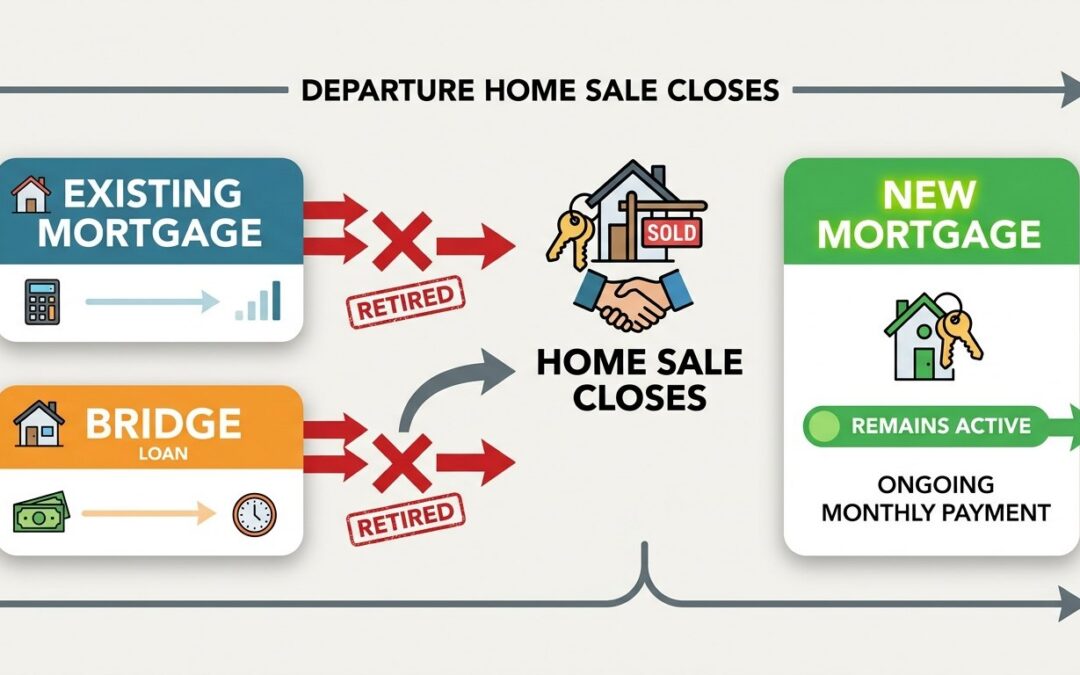
These responsibilities include your current mortgage, the temporary bridge financing, and the new mortgage for your next home. Underwriters evaluate all three debts, meaning your total household qualification profile must support this substantial monthly load. Fortunately, the timing of real estate transactions prevents most borrowers from having to make payments on all three loans at the same time.
When you close on your new home, your initial monthly payment is typically deferred for six to eight weeks. This intentional processing window provides a convenient runway to complete your pending real estate transactions. You can sell your current home, pay off the original mortgage, and retire the bridge loan before the stacked payments arrive. Most homebuyers successfully finalize their departure property sales well within this transition window.
Bridge financing programs are a relatively inexpensive way to secure short-term real estate capital. Interest rates float with the prime index, while minimal closing costs cover standard title work and local county recording fees. Since borrowers repay these loans quickly, the total cost of carry is manageable for most families.
Homebuyers must understand that lenders do not advance 100% of the borrower’s available equity on a bridge loan. Underwriters intentionally maintain an equity safety cushion to protect your financial position during the transition. This protective equity buffer preserves your ability to lower your current home’s asking price if local market conditions shift unexpectedly.
“Most people never make a payment on a bridge loan. The closing costs are minimal. It’s just what’s needed to get recorded and title work done. It’s an opportunity for people to take that equity and give them a big down payment so their new house payment is lower and they don’t have to refinance later.” – Tevis Durbin, Producing Branch Manager (NMLS #424899)
Managing Timelines If Your Current Property Sale Runs Long
Many move-up buyers express reasonable concern regarding potential delays when selling their current property. Managing three simultaneous debt obligations creates a strong financial incentive to price your current property correctly.
This market urgency helps keep most bridge financing timelines on track. The built-in equity cushion established during underwriting reinforces this protective market behavior. Even after a strategic price reduction, most sellers retain sufficient proceeds to fully retire all underlying loan balances.
Underwriters withhold this equity buffer intentionally to ensure your transition timeline remains workable if local market conditions slow. Borrowers who encounter complications with bridge financing are almost always those who initially overpriced their current home. Pricing the property accurately ensures the lending structure operates exactly as experts designed it to.
Review the official CFPB mortgage qualification guidelines to understand how lenders evaluate combined debt obligations across multiple properties.
Mortgage Recasting Strategies as a Lower-Pressure Alternative
For move-up buyers seeking a similar outcome with less short-term complexity, a mortgage recast represents an attractive alternative. Under this framework, you purchase your next home using the minimum required down payment guidelines. At closing, you hold only your current mortgage and the new purchase loan, without any temporary bridge debt.
Once your current home sells, you apply those net sales proceeds as a single lump-sum principal payment. Your lender then recalculates the monthly mortgage payment by spreading the reduced balance across your remaining loan term. This update requires no loan refinancing, no new underwriting applications, and no added closing costs.
This process delivers a lower monthly payment on your next home without requiring a massive upfront capital investment. However, the primary trade-off is that your real estate purchase offer must still carry a standard sale contingency.
“It’s still a contingent offer, but they put down the minimum amount of money to buy the new home, so they only have their current loan and the new loan. When the departure home sells, we allow them to make a one-time payment towards the principal. We recast it and lower their payment. It’s not a refinance. It allows them to not worry about having three loans and still get that lower payment on the new home.” – Tevis Durbin, Producing Branch Manager (NMLS #424899)
Determining which mortgage structure fits your active equity position requires a detailed financial analysis. Connect directly with the Durbin Team before submitting your next real estate purchase offer.
Selecting the Ideal Loan Framework for Your Transition
Selecting the correct framework depends heavily on four primary variables. These factors include neighborhood competition, local sales velocity, available home equity, and your total qualifying monthly income.
Submitting a contingency-free purchasing offer is attractive to sellers navigating multiple competitive bids. In crowded marketplace scenarios, unencumbered offers are frequently the only options that listing agents will accept. Buyers who cannot waive their sale contingencies are routinely passed over, regardless of the purchase price they offer.
In slower local markets where timing is predictable, a mortgage recast delivers identical payment reductions with less pressure. Your purchase offer remains technically contingent, but your ultimate long-term financial position at closing remains comparable.
Review our post, “Fishers Home Buyers Have Real Leverage in 2026,” to understand current negotiating dynamics.
Reviewing Credit Scores and Income Criteria for Multiple Obligations
Securing approval for three simultaneous monthly housing obligations is never automatic in underwriting. Underwriters analyze your complete debt profile, incorporating your current mortgage balance, the bridge financing, and the new purchase loan. Your debt-to-income ratio must accommodate all three payments to satisfy federal guidelines.
Most bridge loan programs require a baseline credit score of at least 680. Your financial verification documents must satisfy the strict Qualified Mortgage guidelines established by federal consumer protection agencies. Salaried borrowers typically qualify by providing two full years of employment history and recent pay stubs. Self-employed borrowers must have two years of personal tax returns showing sufficient income to support the combined load.
Your calculated loan-to-value ratio represents another critical factor during the underwriting review process. Underwriters calculate your available bridge advance by subtracting your outstanding mortgage balance from the property’s current appraised value.
Common Questions About Bridge Financing
How does a bridge loan affect my debt-to-income ratio during qualification?
Your debt ratio calculation incorporates all three concurrent housing obligations throughout the active real estate transition period. Underwriters apply traditional debt-to-income percentage caps to this combined multi-loan payment total. If your verified monthly income cannot support all three notes simultaneously, underwriters cannot issue an approval. Opting for the alternative recast framework requires managing only two active obligations, simplifying your income qualification guidelines.
Can I use a bridge loan if I have already listed my current home but have not accepted an offer?
Your current property does not need to hold an active purchase contract to secure an underwriting approval. Mortgage underwriters evaluate your available equity cushions and verified monthly income rather than checking your active escrow status. Maintaining an active public MLS listing demonstrates a clear intent to sell, reinforcing investor confidence in your strategy.
Which loan programs are compatible with bridge financing on the purchase side?
Bridge financing structures pair most effectively with standard conventional purchase mortgages on your next home. The primary bridge instrument functions as a short-term note secured by your current home. Your next purchase mortgage can use conventional, jumbo, or alternative federal programs based on your profile. Managing both loans through a single local branch simplifies communication throughout the underwriting process.
What happens to the bridge loan if my home sale falls through?
If your existing home sale falls through, your bridge financing remains active, and interest continues to accrue. Most temporary bridge notes feature a six-to-twelve-month expiration window, providing ample runway to relist your property. This timeline demonstrates why accurately pricing your current home from day one is critical.
Is a mortgage recast available on all loan types?
Mortgage recasting options are standard features across most conventional conforming loans backed by national housing agencies. Government-backed options like FHA and VA loans strictly prohibit recasting mechanisms under federal processing rules. Non-conforming jumbo loan guidelines vary widely by corporate servicer.
How much does a mortgage recast typically cost?
Most loan servicing companies charge a flat administrative fee ranging from $150 to $500. This streamlined processing option requires no new closing fees, no fresh appraisals, and no title updates. The total fee and minimum principal reduction thresholds vary significantly based on your loan servicer. Confirming these servicing guidelines during your initial loan origination phase is highly recommended.
Will bridge loans appear on my credit report?
Active bridge loans represent mortgage liabilities that report to national credit reporting bureaus. This debt instrument contributes to your cumulative liability metrics while the loan balance remains outstanding. Once your departure home closes, the account terminates, removing all pressure on your debt ratios. Most repeat buyers hold these temporary balances for 30 to 90 days, significantly limiting the impact on their credit scores.
Gaining an Edge in Competitive Markets
Move-up buyers gain serious leverage when they remove sale contingencies from their offers. Bridge loans and recast strategies create clear paths to that flexibility. The right structure depends on your equity position, income strength, and local market competition.
The team from Supreme Lending guides buyers through both bridge loan and recast strategies every day. We’ll help you align your financing with your timeline and local market conditions. Reach out today to build a plan that supports your next purchase.
ABOUT THE EXPERT
Tevis Durbin (NMLS #424899) is a Producing Branch Manager at Supreme Lending with over 26 years of experience in the mortgage industry. Leading “The Durbin Team,” Tevis combines his deep financial background, holding an MBA in Finance and a degree in Economics, with specialized loan programs to help Midwest homebuyers navigate complex markets. He is a Certified Mortgage Advisor, serves on the State Board for the Mortgage Bankers of Indiana, and acts as the Communication Chair for the Hamilton County division of MIBOR.